AI that survives contact with the enterprise.

Federal AI policy and the NIST AI Risk Management Framework now expect model inventories, impact assessments, and documented human oversight. Most pilots were never built to produce any of it.

Agiletek starts from the business goal, fixes the data underneath it, and puts governance in place before the model ships, so what you build is defensible to an auditor and useful on a Monday morning.

Define the business outcome
before you choose the model.

The question is never which model to use. It is which decision is slow, expensive, or
inconsistent today, and what evidence would prove it improved. We work backwards
from that.

01

Name the outcome

Pick a decision that costs real money today. Cycle time, backlog, error rate, or risk.

02

Locate the truth

Find where the data actually lives, who owns it, and whether it's complete enough to trust.

03

Match the method

Retrieval, classification, forecasting, or a language model. The cheapest approach that clears the bar wins.

04

Prove and scale

Ship a narrow version, measure it against the baseline, then widen only what earns its place.

Where language models genuinely help

Large language models are one work of a specific shape of problem: work buried in unstructured text. They are a poor substitute for a database, a rules engine, or a
decision your organization is accountable for.

Document-heavy work

Summarizing, comparing and extracting structure from contracts, reports, and case files that people currently read line by one.

Knowledge retrieval

Grounded answers drawn from your own policies and documentation, with citations back to the source paragraph.

Service and support

Drafting responses, classifying and routing tickets, and surfacing the right knowledge article to an agent mid-conversation.

Code and migration

Reading legacy code, explaining undocumented systems, and drafting test coverage during modernization work.

Analyst augmentation

Turning a plain-language question into a query, then explaining what the result does and does not support.

Process discovery

Reading tickets, logs, and transcripts to find the repetitive work automating is the first place.

We do not resell a single vendor. Model choice follows the data residency, latency, and cost constraints of the environment, and stays swappable so a better model next
quarter’s change is a configuration change rather than a rebuild.

Four ways we harden
the environment.

From governance through active defense, delivered by engineers who have worked
inside accredited environments.

AI Readiness Assessment

Find what is in the way

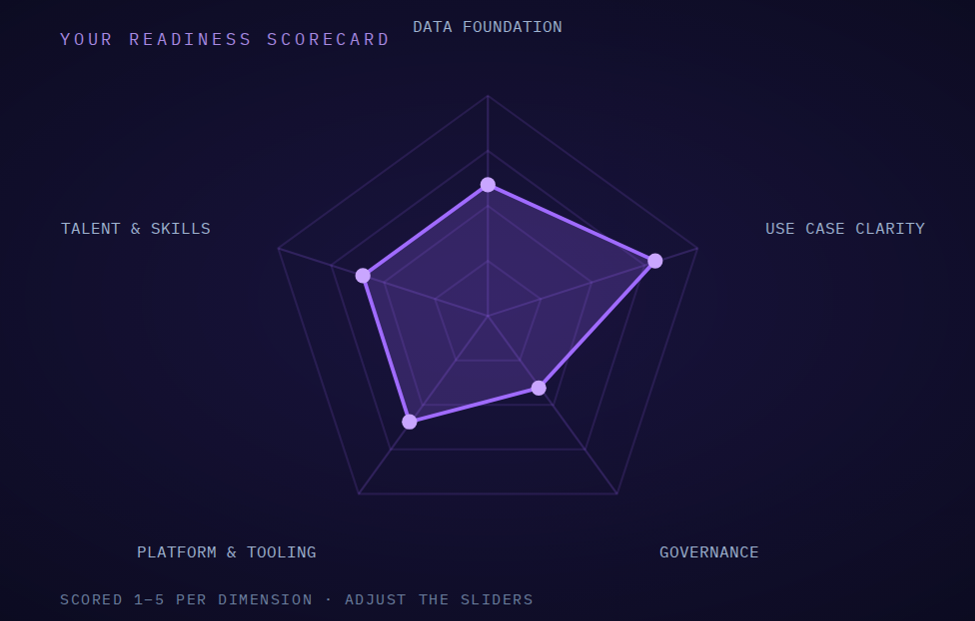
A structured four-week review scoring five dimensions, ending in a plain answer on which use cases are ready now and which need data work first.
1: Scored baseline across five dimensions
2: Ranked use case backlog with owners
3: Gap remediation plan and business case

Data Foundation & Governance

The part that reaches production

Back paragraph: Lineage, ownership, and access controls that let a security officer approve a system and let you explain a decision months later.
1: Data lineage with a named owner per source
2: Access, residency and tenancy rules
3: Model inventory and audit evidence

Applied AI Delivery

The cheapest method that clears the bar

Retrieval, classification, forecasting, or a language model, chosen against the decision you are trying to improve rather than the technology you want to use.
1: Grounded retrieval over your own material
2: Model-neutral across GPT, Claude and open weights
3: Narrow release measured against a baseline
AI Center of Excellence

A standing capability

One place where AI expertise, governance, and delivery discipline live together, so AI work stays aligned to strategy instead of scattering into competing pilots.
1: Governance structure and advisory board
2: Ethics guidelines and compliance monitoring
3: KPIs defined up front and reviewed on a cycle

A standing capability, not a one-off project team.

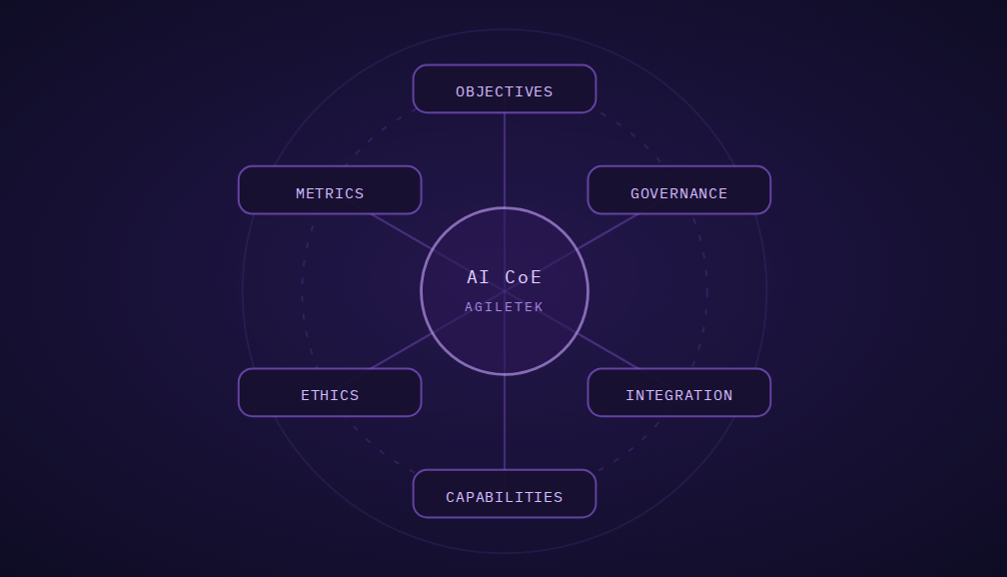
Our AI Center of Excellence gives an organization one place where AI expertise, governance, and delivery discipline live together. It sets the objectives, holds the standards, and keeps AI work aligned to operational excellence and security rather than being scattered across competing pilots.

AI CENTER OF EXCELLENCE OFFERING

View The Full Deck

Objectives and scope

Sharpen operational efficiency, strengthen resilience against evolving cyber threats, and accelerate innovation through predictive analytics and machine learning.

Governance structure

A CoE director backed by an advisory board of AI, industry, and security specialists, with subcommittees owning each focus area.

Integration with existing functions

AI objectives tied to enterprise strategy, and operations rather than living alongside IT, security, and operations rather than living alongside it.

Capabilities and infrastructure

Secure, scalable compute and storage sized for real workloads, plus academic partnerships and training that build the bench internally.

Ethical AI use

Written guidelines covering transparency, accountability, fairness, and security, with active monitoring against privacy regulation and policy.

Performance metrics

KPIs defined up front across efficiency, cost, and experience, and security, reviewed on a cycle so strategy adjusts to evidence.

Score yourself in sixty seconds.

Rate your organization on each dimension and watch the profile build. A structured four-week review does this properly, with evidence behind every score and a ranked use case backlog at the end.

Developing

Foundations are forming. Native, well-governed use cases are viable now.

The part that decides whether
any of it reaches production.

Governance is not a document you write at the end. It is the set of controls that let a
security officer approve a system, and let you explain a decision months later.

Data lineage and ownership

Every dataset feeding a model has a named owner, a documented source, and a traceable origin of output.

Access and residency

Role-based access, tenancy isolation, and clear rules on what data may leave the boundary and what never does.

Model inventory

A register of every model in use: what it does, who approved it, who was trained or grounded on, and when it was last reviewed.

Evaluation and drift

Accuracy, bias, and safety measured against a held-out baseline, then monitored so degradation surfaces early.

Human oversight

Defined decision rights, so consequential output are reviewed by a person with the authority and context to overrule them.

Audit evidence

Prompts, retrievals, versions, and approvals logged as evidence an assessor can read without asking your team for it.

What good looks like.

We agree the measure before the build, against your current baseline, so the result is
arguable in either direction.

Operational efficiency

Less manual, repetitive work. Automating the routine handling inside document review, ticket triage, and reporting, so skilled people spend their hours on judgment instead of transcription.

Decision speed

Shorter time from question to answer. Overworked reviewer over your own material compared against the currently how many days into the length of a conversation.

Security resilience

Earlier detection, faster triage. Pattern analysis across telemetry and vulnerability data to raise the signal your security team acts on and reduce the noise it drools out.

Cost to serve

Lower unit cost, visible per workload. Right-sized models, cached retrieval, and hosted FinOps on inference, so spend tracks value instead of drifting quietly upward.

What we're thinking about.

Start with one decision worth improving.