
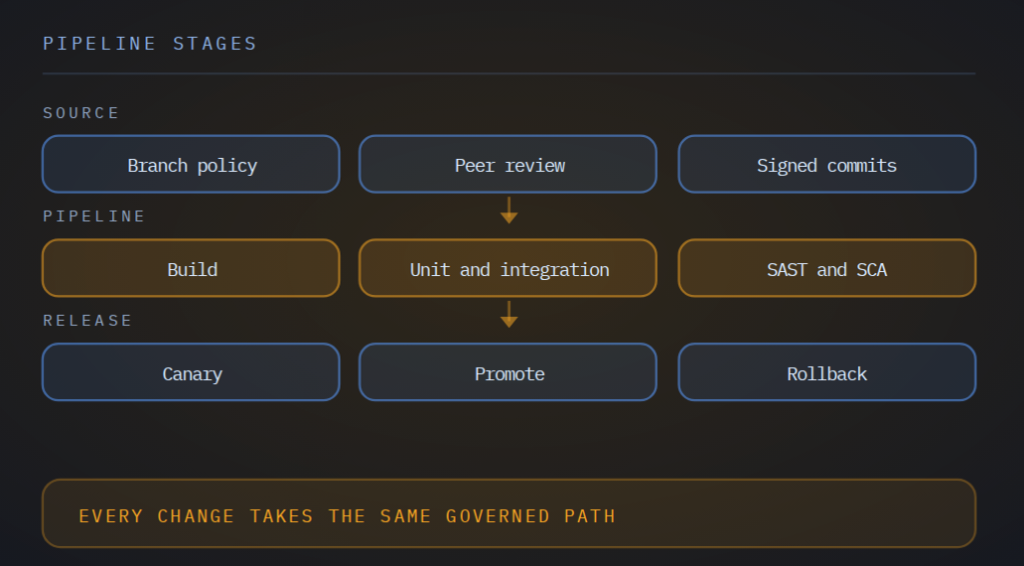
Build, test, and deployment automation with quality and security gates that run on every commit.
Environments provisioned from version-controlled definitions, so drift is visible and reversible.
Canary and blue-green release patterns that limit blast radius and make rollback routine.
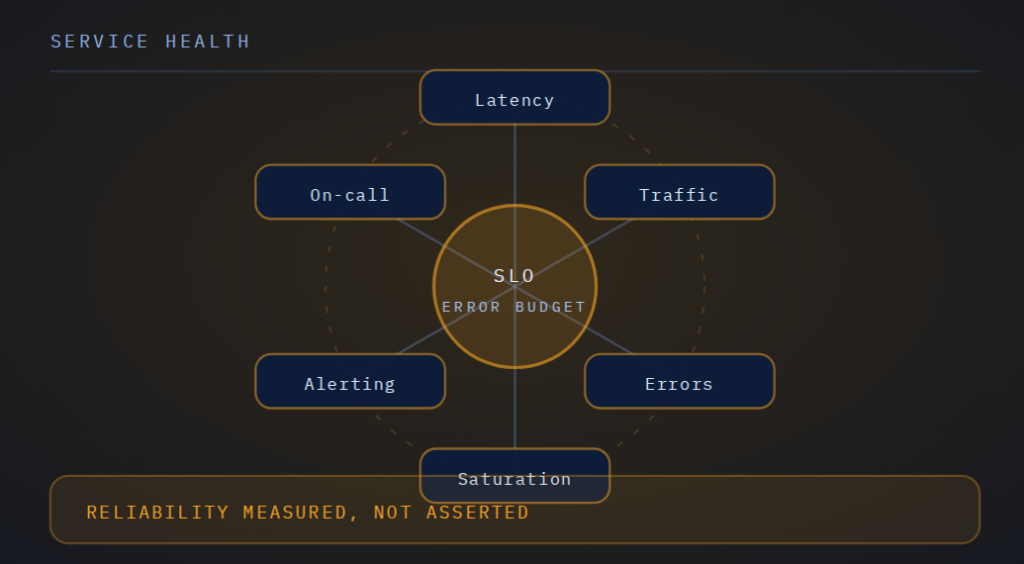
Latency, traffic, errors, and saturation instrumented per service and visible on one pane.
Reliability targets agreed with the business, with error budgets that govern release pace.
Alerts tied to user-visible symptoms, so on-call pages mean something and noise gets deleted.
Paved, supported templates so product teams ship without reinventing infrastructure each time.
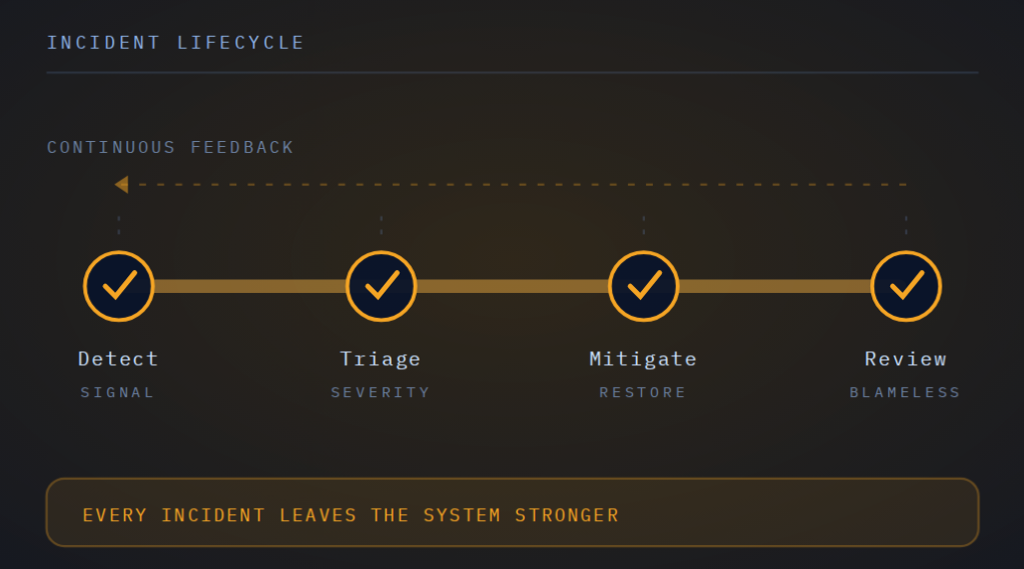
Structured response, blameless review, and corrective actions that actually get scheduled.
Repetitive operational work identified, measured, and automated out of the on-call rotation.
Build, test, and deployment automation with quality and security gates that run on every commit, fast enough that nobody routes around it.
1: Pipeline design and release engineering
2: Security and policy gates in the pipeline
3: Canary and blue-green rollout with rollback
Supported templates and shared services so product teams ship without rebuilding infrastructure for every project.
1: Golden paths and reusable templates
2: Environments provisioned from version control
3: Self-service with guardrails built in
Instrumentation and reliability targets that turn stability into a number engineering and the business both agree on.
1: Golden signals instrumented per service
2: SLOs and error budgets that govern pace
3: Alerting tied to user-visible symptoms
Running the platform day to day, including the parts that only show up at three in the morning.
1: Monitoring, patching and incident response
2: Blameless review with corrective actions scheduled
3: Toil measured and automated out of the rotation
We have hardened DevSecOps pipelines inside sensitive federal environments, where
a release path has to be both fast and fully accountable.
Scanning and policy gates built into the pipeline rather than bolted on before audit.
Every deployment traceable to a commit, a review, and an approval.
SLOs, error budgets, and incident review as standing practice, not a maturity slide.
Delivery teams who can operate inside restricted environments.
With the path to production as it exists today, mapped honestly, including the manual steps. The first automation targets whatever is both riskiest and most repeated, which is usually the deployment itself rather than the build.
Security gates move into the pipeline: dependency scanning, static analysis, and policy checks run per commit, and their output becomes the compliance evidence. That shortens the path from code to accredited release without weakening the control.
Service level objectives are explicit reliability targets, like a percentage of requests served under a latency threshold. They matter because they turn stability into a number both engineering and the business agree on, and they set a defensible pace for releases.
Both. Many clients have us build the delivery platform and then operate it, including monitoring, incident response, and on-call, while their teams focus on the applications.